Kanuka is an evergreen tree belonging to the genus Kunzea in the Myrtaceae family, locally, its leaves are primarily consumed as herbal tea, and little is known about its physiological effects or chemical constituents. On the other hand, bile acids play a role in micellizing dietary fats and cholesterols, facilitating their absorption from the intestinal tract into the bloodstream. Therefore, bile acid micelles disruption (BAMD) could inhibit fatty acid absorption and possibly suppress obesity-related blood indexes and body weight gain. In the present study, we found a water-soluble Kanuka (Kunzea ericoides) leaf extract (KWE) that exhibited the following novel significant effects related with obesity: 1) potent BAMD activity (50% BAMD at 0.15 mg/mL); 2) reduced adipose tissue weights of perirenal, peritesticular mass weight compared with the control group, perirenal fat mass weight was significantly increased in the HFD group but was significantly reduced (p<0.05) in the HFD+KWE group, and intrahepatic fat content when compared to the control group, negligible changes were observed in the HFD group, while significantly reductions were observed in the HFD+KWE group; and 3) lowered blood indexes (total cholesterols and triglyceride levels) with reduction tendency towards body weight gain in male C57BL/6J mice. As far as we know, our present endeavor is the first documented study that showed KWE to elicit suppressive effects on obesity-related parameters in mice.
This is an Open Access article, distributed under the terms of the Creative Commons Attribution 4.0 International License (http://creativecommons.org/licenses/by/4.0/), which permits unrestricted use, distribution and reproduction in any medium or format, provided the original work is properly cited.
Kanuka (Kunzea Ericoides), Bile Acid Micelles Disruption, Anti-obesity Effects, Mice
1. Introduction
Obesity is the root cause of many chronic diseases that include diabetes, hypertension and dyslipidemia. We demonstrated touchi-extract anti-diabetic and anti-dyslipidemic effects via alpha-glucosidase inhibitory activity
[1]
Fujita, H., Yamagami, T and Ohshima, T., Fermented soybean–derived water-soluble touchi extract inhibits alpha-glucosidase and is Antiglycemic in rats and humans after single oral treatments. J. Nutri., (2001). 131, 1211-1213.
Fujita, H., Yamagami, T and Ohshima, T., Long-term ingestion of a fermented soybean-derived touchi-extract with alpha-glucosidase inhibitory activity is safe and effective in humans with borderline and mild type-2 diabetes. J. Nutri., (2001), 131(8): 2105-2108.
Fujita, H., Yamagami, T and Ohshima, T., Efficacy and safety of touchi extract, an alpha-glucosidase inhibitor derived from fermented soybeans, in non-insulin-dependent diabetic mellitus. J. Nutri. Biochem., (2001).12, 351-356.
Fujita, H., Yamagami., Fermented soybean-derived touchi-extract with anti-diabetic effect via alpha-glucosidase inhibitory action in a long-term administration study with KKAy mice. Life Sci., (2001). 70(2): 219-227.
. Hitherto, many research studies have been focused on foods and their extracts that exhibit anti-obesity effects through mechanisms such as lipase inhibition
[5]
Oi, Y., Hou, I, C., Fujita, H and Yazawa K. Antiobesity effects of chinese black tea (Pu-erh Tea) extract and gallic acid. Phytother. Res., (2011).
Kubota, K., Sumi, S., Tojo, H., Sumi-Inoue, Y, I-Ching., Oi, Y., Fujita, H., and Urata, H. Improvements of mean body mass index and body weight in preobese and overweight Japanese adults with black Chinese tea (Pu-Erh) water extract. Nutr. Res. (2011).31, 421–428.
. however, other mechanisms remain unexplored to date. In the present study, we adopted an approach of studying the effects of our isolated novel water-soluble extract from Kanuka (Kunzea ericoides) leaves (KWE) on obesity-related blood indexes and body weight changes via the mechanism of bile acid-mediated fat absorption.
Bile acids are synthesized from cholesterols and are amphiphilic compounds possessing a steroid skeleton consisting of 24 carbon atoms. They are secreted from the gallbladder into the small intestine, where they aid in the digestion and absorption of dietary fat-soluble components via emulsification and micelle formation. Approximately 95% of these secreted bile acids are reabsorbed via the action of the intestinal bile acid transporter in the lower small intestine and return to the liver via the portal vein: a process known as the enterohepatic circulation. After approximately 10 cycles of enterohepatic circulation, the bile acids are ultimately excreted in feces. Therefore, inhibiting the action of these bile acids is expected to not only suppress the absorption of fat-soluble substances and exhibit anti-obesity effects, but also reduce the amount of bile acids reabsorbed, thereby potentially lowering blood cholesterol levels. Such activities have also been observed in plant sterols
[7]
Ikeda, I., Tanaka, K., Sugano, M., Vahouny V. V. and Gallo, L. L. Inhibition of cholesterol absorption in rats by plant sterols. J. Lipid Res., (1988) 29. 1573-1582.
Kobayashi, M., Unnno, T., Suzuki, Y., Nozawa, A., Sagesaka, Y., Takuda, T. and Ikeda, I. Heat-Epimerized Tea Catechins Have the Same Cholesterol-Lowering Activity as Green Tea Catechins in Cholesterol-Fed Rats. Biosci. Biotechnol. Biochem. (2005). 69(12), 2455–2458.
Nagaoka, S., Miwa, K., Eto, M., Kuzuya, Y. and Hori, G. Soy protein peptic hydrolysate with bound phospholipids decreases micellar solubility and cholesterol absorption in rats and caco-2 cells. J. Nutr., (1999). 129: 1725–1730.
which have been reported to exhibit anti-obesity effects in rats
[10]
Ikeda, I., Yanabe, Y. and Sugano, M., Effects of sitosterol and sitostanol on micellar solubility of cholesterol. J. Nutr. Sci. Vitaminol., (1989).35, 361-369.
Ikeda, I., Yamahira, T., Kato, M. and Ishikawa. Black-tea polyphenols decrease micellar solubility of cholesterol in vitro and intestinal absorption of cholesterol in rats. J. Agric. Food Chem. (2010).58, 8591–8595.
Focusing on the bile acid micelle disruption (BAMD) activity and the previously demonstrated suppressive effects of various food and plant extracts
[12]
Fujita, H. and Yamagami, T. Antihypercholesterolemic effect of Chinese black tea extract in human subjects with borderline hypercholesterolemia. Nutr. Res., (2008). 28: 450–456.
on obesity-related blood indexes, such as glucose (Glu) total cholesterol (TC), low-density lipoprotein cholesterol (LDL-C), triglyceride (TG) levels, and body weight gain, we investigated a newly discovered hot water extract (Kanuka leaf water extract; KWE) from Kanuka (Kunzea ericoides), a plant native to New Zealand, for its effects on obesity-related parameters in the present study.
Kanuka is an evergreen tree belonging to the genus Kunzea in the Myrtaceae family, reaching heights of up to 18 m. Locally, its leaves are primarily consumed as herbal tea, and little is known about its physiological effects or chemical constituents. There are few reports on kanuka itself, but honey derived from kanuka flowers has been reported to possess antiviral
[13]
Semprini, A., Singer, J., Braithwaite, I., Shortt, N., Thayabaran, D., McConnell, M., Weatherall, M. and Beasley, Richard. Kanuka honey versus aciclovir for the topical treatment of herpes simplex labialis: a randomized controlled trial. Br. Med. J., (2019).14; 9(5): e026201.
Tomblin, V., Ferguson. L., Han, D Y., Murray, P. and Schlothauer, R. Potential pathway of anti-inflammatory effect by New Zealand honeys. Int. J. Gen. Med., (2014). 5(7), 149-58.
Braithwaite, I., Hunt, A., Riley, J., Fingleton, J., Kocks, J., Corin, A., Helm, C., Sheahan, D., Tofield, C., Montgomery, B., Holliday, M., Weatherall, M. and Beasley, R. Randomised controlled trial of topical kanuka honey for the treatment of rosacea. Br. Med. J., (2015). 24; 5(6): e007651.
. However, to date, no reports exist on kanuka effects related to lifestyle-related diseases, such as anti-obesity effects.
2. Materials and Methods
2.1. Reagents
3-sn-Phosphatidylcholine from egg yolk, gallic acid and cholesterol were purchased from Fujifilm Wako Pure Chemical Corporation (Osaka, Japan). Taurocholic acid sodium salt (>95%), aluminum oxide (activated/neutral), and Brockmann I were purchased from Sigma-Aldrich Co. (St Louis. MO. USA). The membrane filter (PTFE; pore size: 0.22 µm) and filter paper (No. 5C) were commercially available from Advantec Toyo Kaisha, ltd. (Tokyo, Japan). All other chemicals used in this study were of the highest available purity.
2.2. KWE Preparation
Kanuka leaf water extract (KWE) was provided by BHN Co., Ltd. Preparation method is as follows: Kanuka leaves (100 g; cultivated in New Zealand) was milled and suspended in 1,000 mL of water before being autoclaved for 60 min two times to ensure extraction. This was followed by centrifugation at 3,000 rpm for 7 min at room temperature, and the supernatant was filtered (No. 5 filter paper). The filtrate was concentrated before being freeze-dried (28 g). The powder thus obtained was the KWE used in this study.
2.3. BAMD Activity
BAMD activity of KWE was measured using the Ikeda method
[11]
Ikeda, I., Yamahira, T., Kato, M. and Ishikawa. Black-tea polyphenols decrease micellar solubility of cholesterol in vitro and intestinal absorption of cholesterol in rats. J. Agric. Food Chem. (2010).58, 8591–8595.
with modifications. The micellar solution contained 6.6 mM sodium taurocholate, 0.5 mM cholesterol, and 0.6 mM egg yolk lecithin; these were prepared in 15 mM sodium phosphate buffer (pH 7.4) using sonication.
Samples (100 µL each) were evaluated by mixing with 1.9 mL of the micelle solution and incubated (37 °C) for 1 h. The PTFE membrane filter (pore size: 0.22 µm) was used to remove the cholesterol released from the micelles, and aluminum oxide was added to remove the polyphenols contained in the sample before centrifugation (1,000 rpm, 5 min). Each supernatant sample (500 µL) was mixed with an equal volume of cholesterol E-test WAKO agent (Fujifilm Wako Pure Chemical Corporation, Osaka, Japan), and incubated (37 °C) for 10 min before measuring the absorbance at 600 nm. The IC50 value is the concentration of 50% BAMD inhibition activity in the reaction mixture.
2.4. Animals and Diets
Five-week-old male C57BL/6 mice (Japan SLC, Inc., Shizuoka, Japan) were individually housed in stainless steel wire cages (in cm) (H: 17, W: 25, L: 37) and were maintained at 22 °C and 55% relative humidity, with a 12-h alternating light/dark cycle (8:00–20:00 h). Animals were given free access to drinking water and a 14% casein diet based on AIN-93M for 1 week (wk). The mice were randomly assigned to three groups of 8 each: control (Control), high-fat diet (HFD), and HFD+KWE groups. The HFD contained the following ingredients (g/kg), casein (256.0), L-cystine (3.6), maltodextrin (60.0), corn starch (160.0), sucrose (55.0), soybean oil (20.0), lard (330.0), cellulose (66.1), AIN-93 VX (10.0), and choline bitartrate (2.5). The HFD+KWE diet was prepared by adding 1% KWE to the HFD feed. All animal experimental protocols were approved by the Kyoto University of Advanced Science Animal Research Committee (approval number: K0014) and performed in accordance with the guidelines for animal experiments of Kyoto University of Advanced Science.
2.5. Experimental Design
Body weight and food intake were measured daily throughout the 12-wk study period. Feces were collected from wk 11 to 12 (7-day period) and freeze-dried prior to monitoring the required measurements of samples. The study was terminated by sacrificing the mice with urethane at 09:00 h after 12-h fast. Blood was collected from the femoral vein, and the liver, perirenal, and peritesticular adipose tissues were quickly removed and stored at -80 °C until analysis.
2.6. Biochemical Analysis
Using the respective assays, serum Glu (Glucose CII-test), TC (Cholesterol E-Test), HDL-C (HDL-Cholesterol E-Test), and TG (Triglyceride E-Test) concentrations were determined using commercially available kits from Fujifilm Wako Pure Chemical Corporation (Osaka, Japan). Intrahepatic fat contents were extracted using the Bligh and Dyer method.
2.7. Statistical Analysis
All data are expressed as the mean ± S.E. Statistical analysis was performed using one-way ANOVA followed by Tukey’s post hoc test for multiple comparisons using SPSS (IBM SPSS Statistics, Version 31.0.0.0 IBM Corp., Armonk, NY, USA). A p value of < 0.05 was considered as statistically significant.
3. Results
3.1. Micelle Disruption Activity of KWE
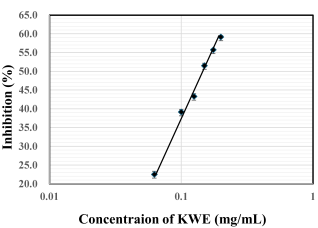
Kanuka extract exhibited dose-dependent BAMD activity (0.1 mg/mL; 39.1±0.7%, 0.15 mg/mL; 51.5±0. 6%, 0.20 mg/mL; 59.1±0.4%, n=3, R2=0.96, Figure 1), with a concentration of 0.15 mg/mL required to disrupt 50% BAMD used as gallic acid for a positive control (IC50 = 0.02 mg/mL). Therefore, KWE showed potent BAMD inhibitory activity.
3.2. Anti-Obesity Effects of Kanuka Extract Administration in Mice
Of the 8 mice in the HFD group, one died on day 9 of the experiment; however, a causal relationship with HFD administration could not be established, and thus the final analysis was performed on 7 mice. Regarding weight gain, when compared with the control group, a significant increase was observed in the HFD group, while no significant differences were found in the HFD+KWE group, although a tendency toward reduced weight gain was noted. When food intake was compared on a weight and calorie basis with the control group, tendencies toward higher intake was observed in the HFD and HFD+KWE groups, although the latter showed slightly higher values without significant differences and there were also no changes in feeding efficiency (control, HFD and HFD+KWE are 0.76, 1.22 and 0.97 g-bw/cal/d). This suggests that the weight gains in feed-treated groups were not due to reduced food or calorie intake (Table 1).
Figure 1. Micelle Disruption Activity of water-soluble Kanuka extract (KWE). Each value represents the mean ± SEM (n=3).Micelle Disruption Activity of water-soluble Kanuka extract (KWE). Each value represents the mean ± SEM (n=3).
Table 1. Effects of KWE on Body Weight and Food Intake During High-Fat Diet Administration in mice.Effects of KWE on Body Weight and Food Intake During High-Fat Diet Administration in mice.Effects of KWE on Body Weight and Food Intake During High-Fat Diet Administration in mice.
Control (n=8)
HFD (n=7)
HFD+KWE(n=8)
Initial Body weight (g)
19.6 ± 0.3a
19.4 ± 0.2a
19.4 ± 0.3a
Final Body weight (g, 85 days)
31.3 ± 0.7a
36.7 ± 1.2a,b
34.1 ± 1.5b
Body weight gain (g, 85 days)
11.8 ± 0.9a
17.3 ± 1.1a,b
14.8 ± 1.5b
Food intake (g/d)
4.02
2.79
3.04
Food intake (cal/d)
15.48
14.12
15.28
Each value is the mean ± SEM of mice per group. Statistical differences where p<0.05) among groups are represented as a and b. HFD: high fat diet; HFD+KWE: high fat diet with kanuka extract
3.3. Effects of KWE on Perirenal and Peri Epididymal Fat Weight
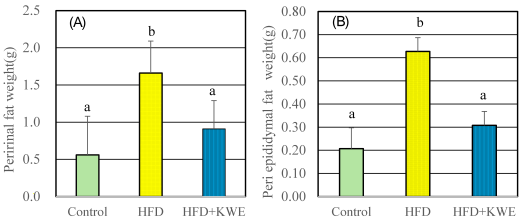
When results of fatty mass weights in adipose tissues of the HFD and HFD+KWE groups (Figure 2) were compared with the control group. As for tissue fat mass weight compared with the control group, perirenal fat mass weight was significantly increased in the HFD group but was significantly reduced (p<0.05) in the HFD+KWE group (Figure 2A). Additionally, when compared on a similar fashion, epididymal fat mass weight was significantly reduced (p<0.05) in the HFD+KWE group (Figure 2B). These results clearly suggest that KWE intake reduces adipose tissue fat weight.
Figure 2. Effects of water-soluble Kanuka extract (KWE) on (A) perirenal and (B) peri epididymal fat weight. Each value represents the mean ± SEM per group. Significant differences (p<0.05) in group comparisons exist between different groups, where a and b represent significant differences. HFD: high-fat diet; and HFD+KWE (HFD supplemented with 1% KWE).Effects of water-soluble Kanuka extract (KWE) on (A) perirenal and (B) peri epididymal fat weight. Each value represents the mean ± SEM per group. Significant differences (p<0.05) in group comparisons exist between different groups, where a and b represent significant differences. HFD: high-fat diet; and HFD+KWE (HFD supplemented with 1% KWE).
3.4. Effects of KWE on Liver Weight and Intrahepatic Fat Content
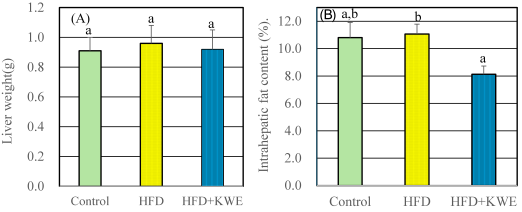
When results of liver weight and intrahepatic fat content of the HFD and HFD+KWE groups were compared with the control group (Figure 3) were compared with the control group, meager differences were noted in the liver weight (Figure 3A). Regarding intrahepatic fat content when compared to the control group, negligible changes were observed in the HFD group, while significantly reductions were observed (p<0.05) in the HFD+KWE group (Figure 3B), suggesting certain fat-reduction effects in the liver probably related to fat metabolism.
Figure 3. Effects of water-soluble Kanuka extract (KWE) on (A) liver weight, (B) intrahepatic fat content (%). Each value represents the mean ± SEM per group. Significant differences (p<0.05) in group comparisons exist between different groups, where a and b represent significant differences. HFD: high-fat diet; and HFD+KWE (HFD supplemented with 1% KWE).Effects of water-soluble Kanuka extract (KWE) on (A) liver weight, (B) intrahepatic fat content (%). Each value represents the mean ± SEM per group. Significant differences (p<0.05) in group comparisons exist between different groups, where a and b represent significant differences. HFD: high-fat diet; and HFD+KWE (HFD supplemented with 1% KWE).
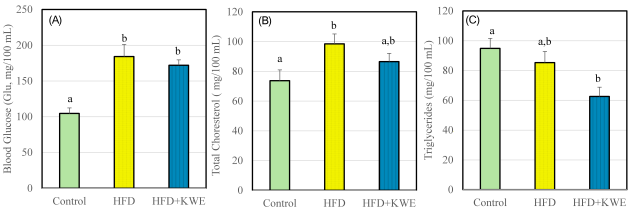
Figure 4. Effects of water-soluble Kanuka extract (KWE) on (A) Blood Glucose, (B) Total Cholesterol, and (C) Triglyceride. Each value represents the mean ± SEM per group. Significant differences (p<0.05) in group comparisons exist between different groups, where a and b represent significant differences. HFD: high-fat diet; and HFD+KWE (HFD supplemented with 1% KWE).Effects of water-soluble Kanuka extract (KWE) on (A) Blood Glucose, (B) Total Cholesterol, and (C) Triglyceride. Each value represents the mean ± SEM per group. Significant differences (p<0.05) in group comparisons exist between different groups, where a and b represent significant differences. HFD: high-fat diet; and HFD+KWE (HFD supplemented with 1% KWE).
3.5. Effects of KWE on TC, TG and Glu
Biochemical blood test results showed that blood Glu levels (Figure 4A) were largely unaffected in the HFD group compared with the control group although TC levels were significantly elevated (Figure 4B). Furthermore, TG level of HFD+KWE group was significant decreased (p<0.05) compared with control group (Figure 4C).
4. Discussion
Kanuka extract exhibited dose-dependent BAMD activity and a concentration of 0.15 mg/mL required to disrupt 50% BAMD. Previous reports have indicated that black tea extracts, particularly those from Hunan tea leaves, exhibit approximately 80% inhibition at 0.2 mg/mL
[11]
Ikeda, I., Yamahira, T., Kato, M. and Ishikawa. Black-tea polyphenols decrease micellar solubility of cholesterol in vitro and intestinal absorption of cholesterol in rats. J. Agric. Food Chem. (2010).58, 8591–8595.
: an equipotent activity, although slight differences in the experimental systems exist. In a turtle experiment on the theaflavins in black tea, theaflavin-3-gallate has been identified as the active component for BAMD; however, the present KWE does not contain such theaflavins, the active compound responsible for this activity is currently under investigation.
Blood Glu levels were largely unaffected in the HFD group compared with the control group although TC levels were significantly elevated. This increase tended to decline in the HFD+KWE group. A similar variation tendency for TG levels was observed in the HFD+KWE group compared to the control group. These results suggest that KWE had a negligible effect on Glu metabolism, although data demonstrated an ameliorative effect on HFD-induced abnormal lipid metabolism. These cholesterol and TG reduction effects are thought to result from improved lipid metabolism, probably achieved by KWE via BAMD activity in the small intestines to thereby reducing lipid absorption.
Green tea catechins possess the activity to release cholesterol from BAMD. Indeed, when green tea catechins were administered to cholesterol-loaded rats, an increase in fecal cholesterol was observed
[8]
Kobayashi, M., Unnno, T., Suzuki, Y., Nozawa, A., Sagesaka, Y., Takuda, T. and Ikeda, I. Heat-Epimerized Tea Catechins Have the Same Cholesterol-Lowering Activity as Green Tea Catechins in Cholesterol-Fed Rats. Biosci. Biotechnol. Biochem. (2005). 69(12), 2455–2458.
. Since fecal weight was increased in the KWE group compared to the HFD group however fecal fat weight was not significant difference was found (data not shown). This effect suggested that KWE may have increased thermogenesis in brown adipose tissue. increases in uncoupling protein (UCP)-1 transcription in brown adipose tissue (BAT) of mice following a single oral dose of flavan 3-ol (FL)s, a fraction of catechins and procyanidins
[16]
Ishii, Y., Muta, O., Teshima, T., Hirasima, Nayuta., Odaka, M., Fushimi, T., Fujii, Y. and Osakabe, N., Repeated Oral Administration of flavan-3-ols induces browning in mice adipose tissues through sympathetic nerve activation. Nutrients, (2021). 13, 4214.
. The various bioactive substances contained in KWE are currently being isolated and structurally characterized. We are now isolating and determining the structures of various bioactive compounds contained in KWE. Since these compounds may also be present, KWE may have demonstrated its body fat-reducing effect not only through BAMD activity but also by promoting thermogenesis in BAT.
5. Conclusions
The water extract of Kanuka (Kunzea ericoides) leaves (KWE) exhibited potent bile acid micelle disruption (BAMD) activity (50% BAMD at 0.15 mg/mL) in vitro. In the present in vivo study, male C57BL/6J mice were either fed a high-fat diet (HFD-60) or HFD- supplemented with 1% KWE (HFD+KWE) for 12 wk. KWE exhibited the following novel significant effects related with obesity: 1) potent BAMD activity (50% BAMD at 0.15 mg/mL); 2) reduced adipose tissue weights of perirenal, peritesticular, and liver fatty masses; and 3) lowered blood indexes (TC and TG levels) with reduction tendency towards body weight gain. It is noteworthy to mention that the HFD+KWE group exhibited significantly lower adipose tissue weight and blood TG levels as well as liver fat weight, suggesting the potential of KWE to suppress fatty liver tendency. As far as know, the present endeavor is the first documented study that showed KWE to elicit suppressive effects on obesity-related parameters in mice.
This work was carried out using the authors’ own resources and financial support was provided by BHN Co., Ltd.
Data Availability Statement
The data is available from the corresponding author upon reasonable request.
Conflicts of Interest
The authors declare no conflicts of interest.
References
[1]
Fujita, H., Yamagami, T and Ohshima, T., Fermented soybean–derived water-soluble touchi extract inhibits alpha-glucosidase and is Antiglycemic in rats and humans after single oral treatments. J. Nutri., (2001). 131, 1211-1213.
Fujita, H., Yamagami, T and Ohshima, T., Long-term ingestion of a fermented soybean-derived touchi-extract with alpha-glucosidase inhibitory activity is safe and effective in humans with borderline and mild type-2 diabetes. J. Nutri., (2001), 131(8): 2105-2108.
Fujita, H., Yamagami, T and Ohshima, T., Efficacy and safety of touchi extract, an alpha-glucosidase inhibitor derived from fermented soybeans, in non-insulin-dependent diabetic mellitus. J. Nutri. Biochem., (2001).12, 351-356.
Fujita, H., Yamagami., Fermented soybean-derived touchi-extract with anti-diabetic effect via alpha-glucosidase inhibitory action in a long-term administration study with KKAy mice. Life Sci., (2001). 70(2): 219-227.
Kubota, K., Sumi, S., Tojo, H., Sumi-Inoue, Y, I-Ching., Oi, Y., Fujita, H., and Urata, H. Improvements of mean body mass index and body weight in preobese and overweight Japanese adults with black Chinese tea (Pu-Erh) water extract. Nutr. Res. (2011).31, 421–428.
Ikeda, I., Tanaka, K., Sugano, M., Vahouny V. V. and Gallo, L. L. Inhibition of cholesterol absorption in rats by plant sterols. J. Lipid Res., (1988) 29. 1573-1582.
Kobayashi, M., Unnno, T., Suzuki, Y., Nozawa, A., Sagesaka, Y., Takuda, T. and Ikeda, I. Heat-Epimerized Tea Catechins Have the Same Cholesterol-Lowering Activity as Green Tea Catechins in Cholesterol-Fed Rats. Biosci. Biotechnol. Biochem. (2005). 69(12), 2455–2458.
Nagaoka, S., Miwa, K., Eto, M., Kuzuya, Y. and Hori, G. Soy protein peptic hydrolysate with bound phospholipids decreases micellar solubility and cholesterol absorption in rats and caco-2 cells. J. Nutr., (1999). 129: 1725–1730.
Ikeda, I., Yanabe, Y. and Sugano, M., Effects of sitosterol and sitostanol on micellar solubility of cholesterol. J. Nutr. Sci. Vitaminol., (1989).35, 361-369.
Ikeda, I., Yamahira, T., Kato, M. and Ishikawa. Black-tea polyphenols decrease micellar solubility of cholesterol in vitro and intestinal absorption of cholesterol in rats. J. Agric. Food Chem. (2010).58, 8591–8595.
Fujita, H. and Yamagami, T. Antihypercholesterolemic effect of Chinese black tea extract in human subjects with borderline hypercholesterolemia. Nutr. Res., (2008). 28: 450–456.
Semprini, A., Singer, J., Braithwaite, I., Shortt, N., Thayabaran, D., McConnell, M., Weatherall, M. and Beasley, Richard. Kanuka honey versus aciclovir for the topical treatment of herpes simplex labialis: a randomized controlled trial. Br. Med. J., (2019).14; 9(5): e026201.
Tomblin, V., Ferguson. L., Han, D Y., Murray, P. and Schlothauer, R. Potential pathway of anti-inflammatory effect by New Zealand honeys. Int. J. Gen. Med., (2014). 5(7), 149-58.
Braithwaite, I., Hunt, A., Riley, J., Fingleton, J., Kocks, J., Corin, A., Helm, C., Sheahan, D., Tofield, C., Montgomery, B., Holliday, M., Weatherall, M. and Beasley, R. Randomised controlled trial of topical kanuka honey for the treatment of rosacea. Br. Med. J., (2015). 24; 5(6): e007651.
Yamaguchi, S., Yano, Y., Nozaki, T., Kato, M., Fujita, H. (2025). Novel Findings of Anti-obesity Effects of Kanuka (Kunzea Ericoides) Leaf Water Extract in Mice: Bile Acid Micelles Disruption Activity. International Journal of Nutrition and Food Sciences, 14(6), 514-520. https://doi.org/10.11648/j.ijnfs.20251406.23
Yamaguchi, S.; Yano, Y.; Nozaki, T.; Kato, M.; Fujita, H. Novel Findings of Anti-obesity Effects of Kanuka (Kunzea Ericoides) Leaf Water Extract in Mice: Bile Acid Micelles Disruption Activity. Int. J. Nutr. Food Sci.2025, 14(6), 514-520. doi: 10.11648/j.ijnfs.20251406.23
Yamaguchi S, Yano Y, Nozaki T, Kato M, Fujita H. Novel Findings of Anti-obesity Effects of Kanuka (Kunzea Ericoides) Leaf Water Extract in Mice: Bile Acid Micelles Disruption Activity. Int J Nutr Food Sci. 2025;14(6):514-520. doi: 10.11648/j.ijnfs.20251406.23
@article{10.11648/j.ijnfs.20251406.23,
  author = {Sanaka Yamaguchi and Yoshihisa Yano and Tsutomu Nozaki and Masaki Kato and Hiroyuki Fujita},
  title = {Novel Findings of Anti-obesity Effects of Kanuka (Kunzea Ericoides) Leaf Water Extract in Mice: Bile Acid Micelles Disruption Activity},
  journal = {International Journal of Nutrition and Food Sciences},
  volume = {14},
  number = {6},
  pages = {514-520},
  doi = {10.11648/j.ijnfs.20251406.23},
  url = {https://doi.org/10.11648/j.ijnfs.20251406.23},
  eprint = {https://article.sciencepublishinggroup.com/pdf/10.11648.j.ijnfs.20251406.23},
  abstract = {Kanuka is an evergreen tree belonging to the genus Kunzea in the Myrtaceae family, locally, its leaves are primarily consumed as herbal tea, and little is known about its physiological effects or chemical constituents. On the other hand, bile acids play a role in micellizing dietary fats and cholesterols, facilitating their absorption from the intestinal tract into the bloodstream. Therefore, bile acid micelles disruption (BAMD) could inhibit fatty acid absorption and possibly suppress obesity-related blood indexes and body weight gain. In the present study, we found a water-soluble Kanuka (Kunzea ericoides) leaf extract (KWE) that exhibited the following novel significant effects related with obesity: 1) potent BAMD activity (50% BAMD at 0.15 mg/mL); 2) reduced adipose tissue weights of perirenal, peritesticular mass weight compared with the control group, perirenal fat mass weight was significantly increased in the HFD group but was significantly reduced (p<0.05) in the HFD+KWE group, and intrahepatic fat content when compared to the control group, negligible changes were observed in the HFD group, while significantly reductions were observed in the HFD+KWE group; and 3) lowered blood indexes (total cholesterols and triglyceride levels) with reduction tendency towards body weight gain in male C57BL/6J mice. As far as we know, our present endeavor is the first documented study that showed KWE to elicit suppressive effects on obesity-related parameters in mice.},
 year = {2025}
}
TY  - JOUR
T1  - Novel Findings of Anti-obesity Effects of Kanuka (Kunzea Ericoides) Leaf Water Extract in Mice: Bile Acid Micelles Disruption Activity
AU  - Sanaka Yamaguchi
AU  - Yoshihisa Yano
AU  - Tsutomu Nozaki
AU  - Masaki Kato
AU  - Hiroyuki Fujita
Y1  - 2025/12/30
PY  - 2025
N1  - https://doi.org/10.11648/j.ijnfs.20251406.23
DO  - 10.11648/j.ijnfs.20251406.23
T2  - International Journal of Nutrition and Food Sciences
JF  - International Journal of Nutrition and Food Sciences
JO  - International Journal of Nutrition and Food Sciences
SP  - 514
EP  - 520
PB  - Science Publishing Group
SN  - 2327-2716
UR  - https://doi.org/10.11648/j.ijnfs.20251406.23
AB  - Kanuka is an evergreen tree belonging to the genus Kunzea in the Myrtaceae family, locally, its leaves are primarily consumed as herbal tea, and little is known about its physiological effects or chemical constituents. On the other hand, bile acids play a role in micellizing dietary fats and cholesterols, facilitating their absorption from the intestinal tract into the bloodstream. Therefore, bile acid micelles disruption (BAMD) could inhibit fatty acid absorption and possibly suppress obesity-related blood indexes and body weight gain. In the present study, we found a water-soluble Kanuka (Kunzea ericoides) leaf extract (KWE) that exhibited the following novel significant effects related with obesity: 1) potent BAMD activity (50% BAMD at 0.15 mg/mL); 2) reduced adipose tissue weights of perirenal, peritesticular mass weight compared with the control group, perirenal fat mass weight was significantly increased in the HFD group but was significantly reduced (p<0.05) in the HFD+KWE group, and intrahepatic fat content when compared to the control group, negligible changes were observed in the HFD group, while significantly reductions were observed in the HFD+KWE group; and 3) lowered blood indexes (total cholesterols and triglyceride levels) with reduction tendency towards body weight gain in male C57BL/6J mice. As far as we know, our present endeavor is the first documented study that showed KWE to elicit suppressive effects on obesity-related parameters in mice.
VL  - 14
IS  - 6
ER  -
Effects of water-soluble Kanuka extract (KWE) on (A) perirenal and (B) peri epididymal fat weight. Each value represents the mean ± SEM per group. Significant differences (p<0.05) in group comparisons exist between different groups, where a and b represent significant differences. HFD: high-fat diet; and HFD+KWE (HFD supplemented with 1% KWE).
Effects of water-soluble Kanuka extract (KWE) on (A) liver weight, (B) intrahepatic fat content (%). Each value represents the mean ± SEM per group. Significant differences (p<0.05) in group comparisons exist between different groups, where a and b represent significant differences. HFD: high-fat diet; and HFD+KWE (HFD supplemented with 1% KWE).
Effects of water-soluble Kanuka extract (KWE) on (A) Blood Glucose, (B) Total Cholesterol, and (C) Triglyceride. Each value represents the mean ± SEM per group. Significant differences (p<0.05) in group comparisons exist between different groups, where a and b represent significant differences. HFD: high-fat diet; and HFD+KWE (HFD supplemented with 1% KWE).
Yamaguchi, S., Yano, Y., Nozaki, T., Kato, M., Fujita, H. (2025). Novel Findings of Anti-obesity Effects of Kanuka (Kunzea Ericoides) Leaf Water Extract in Mice: Bile Acid Micelles Disruption Activity. International Journal of Nutrition and Food Sciences, 14(6), 514-520. https://doi.org/10.11648/j.ijnfs.20251406.23
Yamaguchi, S.; Yano, Y.; Nozaki, T.; Kato, M.; Fujita, H. Novel Findings of Anti-obesity Effects of Kanuka (Kunzea Ericoides) Leaf Water Extract in Mice: Bile Acid Micelles Disruption Activity. Int. J. Nutr. Food Sci.2025, 14(6), 514-520. doi: 10.11648/j.ijnfs.20251406.23
Yamaguchi S, Yano Y, Nozaki T, Kato M, Fujita H. Novel Findings of Anti-obesity Effects of Kanuka (Kunzea Ericoides) Leaf Water Extract in Mice: Bile Acid Micelles Disruption Activity. Int J Nutr Food Sci. 2025;14(6):514-520. doi: 10.11648/j.ijnfs.20251406.23
@article{10.11648/j.ijnfs.20251406.23,
  author = {Sanaka Yamaguchi and Yoshihisa Yano and Tsutomu Nozaki and Masaki Kato and Hiroyuki Fujita},
  title = {Novel Findings of Anti-obesity Effects of Kanuka (Kunzea Ericoides) Leaf Water Extract in Mice: Bile Acid Micelles Disruption Activity},
  journal = {International Journal of Nutrition and Food Sciences},
  volume = {14},
  number = {6},
  pages = {514-520},
  doi = {10.11648/j.ijnfs.20251406.23},
  url = {https://doi.org/10.11648/j.ijnfs.20251406.23},
  eprint = {https://article.sciencepublishinggroup.com/pdf/10.11648.j.ijnfs.20251406.23},
  abstract = {Kanuka is an evergreen tree belonging to the genus Kunzea in the Myrtaceae family, locally, its leaves are primarily consumed as herbal tea, and little is known about its physiological effects or chemical constituents. On the other hand, bile acids play a role in micellizing dietary fats and cholesterols, facilitating their absorption from the intestinal tract into the bloodstream. Therefore, bile acid micelles disruption (BAMD) could inhibit fatty acid absorption and possibly suppress obesity-related blood indexes and body weight gain. In the present study, we found a water-soluble Kanuka (Kunzea ericoides) leaf extract (KWE) that exhibited the following novel significant effects related with obesity: 1) potent BAMD activity (50% BAMD at 0.15 mg/mL); 2) reduced adipose tissue weights of perirenal, peritesticular mass weight compared with the control group, perirenal fat mass weight was significantly increased in the HFD group but was significantly reduced (p<0.05) in the HFD+KWE group, and intrahepatic fat content when compared to the control group, negligible changes were observed in the HFD group, while significantly reductions were observed in the HFD+KWE group; and 3) lowered blood indexes (total cholesterols and triglyceride levels) with reduction tendency towards body weight gain in male C57BL/6J mice. As far as we know, our present endeavor is the first documented study that showed KWE to elicit suppressive effects on obesity-related parameters in mice.},
 year = {2025}
}
TY  - JOUR
T1  - Novel Findings of Anti-obesity Effects of Kanuka (Kunzea Ericoides) Leaf Water Extract in Mice: Bile Acid Micelles Disruption Activity
AU  - Sanaka Yamaguchi
AU  - Yoshihisa Yano
AU  - Tsutomu Nozaki
AU  - Masaki Kato
AU  - Hiroyuki Fujita
Y1  - 2025/12/30
PY  - 2025
N1  - https://doi.org/10.11648/j.ijnfs.20251406.23
DO  - 10.11648/j.ijnfs.20251406.23
T2  - International Journal of Nutrition and Food Sciences
JF  - International Journal of Nutrition and Food Sciences
JO  - International Journal of Nutrition and Food Sciences
SP  - 514
EP  - 520
PB  - Science Publishing Group
SN  - 2327-2716
UR  - https://doi.org/10.11648/j.ijnfs.20251406.23
AB  - Kanuka is an evergreen tree belonging to the genus Kunzea in the Myrtaceae family, locally, its leaves are primarily consumed as herbal tea, and little is known about its physiological effects or chemical constituents. On the other hand, bile acids play a role in micellizing dietary fats and cholesterols, facilitating their absorption from the intestinal tract into the bloodstream. Therefore, bile acid micelles disruption (BAMD) could inhibit fatty acid absorption and possibly suppress obesity-related blood indexes and body weight gain. In the present study, we found a water-soluble Kanuka (Kunzea ericoides) leaf extract (KWE) that exhibited the following novel significant effects related with obesity: 1) potent BAMD activity (50% BAMD at 0.15 mg/mL); 2) reduced adipose tissue weights of perirenal, peritesticular mass weight compared with the control group, perirenal fat mass weight was significantly increased in the HFD group but was significantly reduced (p<0.05) in the HFD+KWE group, and intrahepatic fat content when compared to the control group, negligible changes were observed in the HFD group, while significantly reductions were observed in the HFD+KWE group; and 3) lowered blood indexes (total cholesterols and triglyceride levels) with reduction tendency towards body weight gain in male C57BL/6J mice. As far as we know, our present endeavor is the first documented study that showed KWE to elicit suppressive effects on obesity-related parameters in mice.
VL  - 14
IS  - 6
ER  -





 Share This Article
 Twitter
 Linked In
 Facebook
 Copy
Copy Download